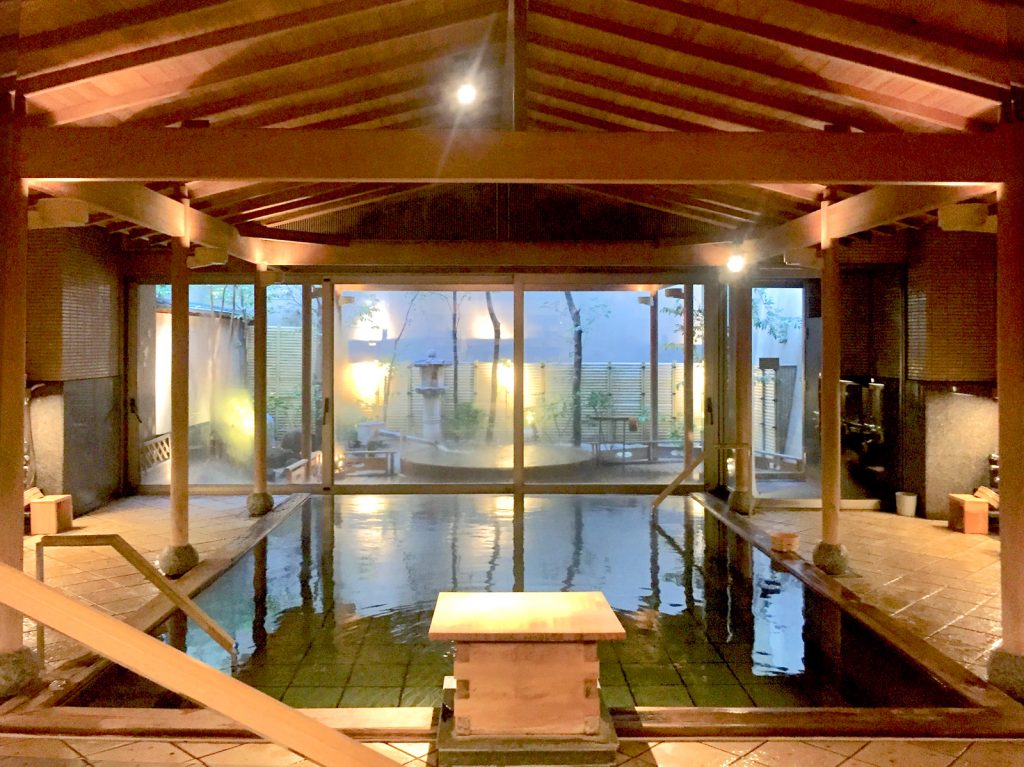
Which term have you heard most, ‘Onsen’, ‘Sento’, or ‘Ofuro’? Same, same but different. Onsen, is a geothermal hot-spring source with all the minerals & good stuff for healing. Sento, is where they use heated tap water and same for Ofuro, but many would struggle to differentiate between any of the three due to the end results. You’ll emerge all rubbery and relaxed, no matter the source.
2. WHY DO JAPANESE LOVE BATHING?
Bathing, for the Japanese, is undertaken for many reasons. It can be purely social a lot of the time, a way to connect with your community or family members. In the bathhouse, status doesn't exist. Rich or poor, powerful businessman or everyday labourer - when naked, everyone is equal. On weekends, I often see Dads and Mum’s taking their children to the bathhouse. As you know, the Japanese can work ridiculous hours, so a soothing, hot, bath with their wee boy or girl is a great way to connect at the end of the week and teaches them the etiquette of bathing.
I became a convert due to a martial art I teach and study. Each year, I take students with me to the head dojo in Tokyo for training. After extensive hours in the dojo each day, there’s nothing better for recovery than a long, hot, bath. Like the dojo, there is a ritual to bathing. There is a kata, a routine. If you want to experience the joy of Japanese bathing then you must know the basics, the kihon.
3. ARE TATTOOS ALLOWED?
A common barrier for westerners to public bathing, apart from an aversion to public nudity, is tattoos. They are regarded as the sign of criminals or yakuza. As such, this non-conforming sub-culture’s decorative and clan-based signalling is frowned upon.
Recently, the ban was officially lifted by law, but most bathhouses still prevent you from entering if you have tattoos. Smaller ones, around the neck and shoulders can be covered with the hand towel you take in with you, but that’s about the only work-around, although friends of mine have put large bandaids over them. Hmmm, not a nice sight for your fellow bathers though. If you have a back tattoo, then you can try sitting with your back to the wall but the only other option is to pay a little more and hire a private.
4. WHAT DO I NEED TO BRING?
At hotels or Ryokan (Japanese Inn), you’ll be given a robe, yukata. They’re comfortable and utilitarian. Don’t be shy to wear them around the hotel or ryokan, it’s perfectly acceptable. To wear them correctly, the left side always folds over the right (the other way is done only when you’re in your coffin) and the belt, obi, goes around the waist in any way you can tie it. There’s no set way to tie them in this scenario, so don’t sweat the small stuff.
5. WHICH DOOR DO I ENTER?
There will be two doors to enter through, rarely are they labelled with any English. The women’s bath is usually colour coded with a red (sometimes pink or burgundy) doorway curtain. The men’s is a blue curtain. At the larger bathhouses, at different times of day, the baths allocated for men and women will switch for cleaning and rotation purposes. Best to double check the doors and signs in the morning if you had a bath the previous night. I got this wrong…once…not a pleasant experience for all involved.
6. WHAT DO I DO?
Grab a locker or a basket, whichever it happens to be. Get completely undressed. The Japanese do not allow ANY clothing in the bath, so it's time to nude up! Leave your big towel behind and take a hair tie if needed and be sure to bring your smaller, hand towel in with you. This item is long but normal hand-towel width and used as a wash cloth, but also a modesty cover, should you be a wee bit shy.
As you enter, there’s usually a large tub of hot, running water and a ladle. Take the ladle and pour, first down your chest, then legs & feet, then arms. This is a token rinse, but also to acclimate your skin to the heat that awaits.
From here, you can go directly into the hot bath for a short moment if you wish, but be careful, the water is often as hot as 42 degrees Celsius. I like to go wash properly first, but the Japanese see it as perfectly acceptable. The quick dip opens the pores of your skin for better cleansing, but I find it a bit off putting.
7. HOW TO BATHE
Find an empty shower spot, rinse off the small stool and sit, never stand. In front of you will be the liquid soaps and hair shampoos. Rinse down and wash your hair first. Then move down the body and use the hand-towel to scrub your entire body as a loofa, not just soap up. Scrubbing every inch of you is essential, not an option.
As a westerner, your technique may be scrutinised by some, so give it your all! Just be careful not to get any soap, or splash any water on your neighbours. If you do, a quick apology and little head and shoulders bow will help diffuse the offence. There’s a large bowl, or small bucket, to use if you wish to fill it for rinsing, or soap up the towel, but the shower head does a more efficient job.
Once you’ve washed everything, and I stress - everything, rinse off thoroughly, as well as the washing area of any soap and be sure to not have a single bubble, anywhere! Rinse out your hand towel thoroughly too. Remember to replace the stool and bowl neatly and rinse off the seat before heading over to the bath. Use the hand towel for modesty if you wish. Men, do this in a very casual manner and often not at all. Women, drape it length-ways down the front of them, holding each corner at the top.
There will often be, but not always, a small bucket or large bowl for you to rinse off your feet, especially at the outdoor bath areas. Whether you believe you have nothing on the soles of your feet or not, use this to rinse them off, even if a token effort. It won’t go unnoticed.
If you have long hair, tie it up, no hair or cloth are allowed in the water. No dipping your head under either or rinsing your towel out in the bath water. If you need to rinse, go back to the shower area. The towel you have with you, can be placed on your head or left on the edge of the bath as long as it isn’t dangling in the water. If you have tattoos you need to cover, then place it carefully and enjoy.
8. SHHH! KEEP THE NOISE DOWN
People often go with friends and you’ll hear some low chatter. Take note, this is the exception. Think of it like a library. Talk if you must, but be mindful of other bathers being there for relaxation. A whisper is as loud as it should get.
Be sure to hop out every so often and hydrate at the water fountains provided, or cool off in the cold water bath or stand-up shower if they have one. Enjoy the sauna or steam rooms too.
My favourite one, near the dojo in Tokyo, has a salt steam room. It’s a whole other blog topic, but used for the healing and ion balancing qualities of salt. Again, be considerate, so noises of heat induced ecstasy or moans and groans of relief are best kept internal. Trust me on this.
9. PACE YOURSELF & ENJOY
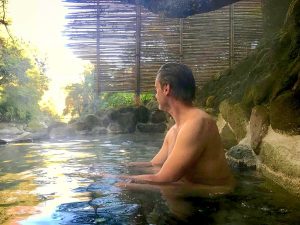
Don’t go hard-core and sit in one bath for an hour. You’ll be sure to pass out like a student of mine almost did once on his first visit. Not a great look to be laying flat out on the floor in your birthday suit with your towel at your feet!
His, was a nervous rookie error. He really struggled with the idea of public nudity even in an acceptable scenario such as this. I’m just glad he didn’t pass out. An unconscious, 6’2”, 105 kg, naked gaijin is not something I wanted to deal with amongst curious, naked, on-lookers.
Once you’ve had enough, go to the area near the rinsing tub you passed on your way in and dry off as best you can with your hand-towel. It’s a definite no no to walk into the changing area, dripping water and sweat on the floor.
You’ll notice cue tips, hair brushes, hair dryers, face toner and moisturisers. Feel free to use these if you like, it’s all part of the package. Remember to re-hydrate. You can lose up to two to three litres of fluid in one bathing!
Perhaps you’ve already had an Onsen experience in Japan or elsewhere? What did you think? How did you fare? If you haven’t tried it, perhaps now with some knowledge you’re brave enough to give it a go?